



Long Island hockey has been on the rise over the last 20 years.
From Boston Bruins defenseman Charlie McAvoy (Long Beach) to Calgary Flames forward Matt Coronato (Greenlawn), Stanley Cup champion Carolina Hurricanes goaltender Brandon Bussi (Sound Beach), New York Rangers defenseman Adam Fox (Jericho), Bruins forward James Hagens (Hauppauge), and Calgary Flames prospect Ethan Wyttenbach (Roslyn), it’s been tremendous to see the growth of hockey on Long Island.
But before those players made their names, the likes of Chris Higgins (Smithtown), Eric Nystrom (Syosset), and Mike Komisarek (West Islip) laid the foundation in the early 2,000s. And we can’t forget two-time Stanley Cup winner Rob Scuderi (Syosset).
Between the Long Island pioneers and the rising stars, a group of Long Island players had to build on that early foundation.
Not all of them made it to the NHL, but they still left their mark on the game.
Josh “Dot” Stone is one of them.
Stone earned the nickname “Dot” in hockey at a young age. It meant winning. It meant period. It meant being straight to the point, with his eyes always on the prize.
People who knew DOT would tell you the same thing: He was the most competitive person on the planet.
That mentality carried him through his playing days and still drives him today.
A kid from Bellmore who grew up playing hockey on Long Island, Stone had dreams of reaching the NHL. But a career-ending shoulder injury, which required multiple surgeries, including procedures involving cadaver tissue, brought those dreams crashing down.
What followed was a dark period for Stone. Hockey was all he knew, and suddenly, the game he had dedicated his life to was taken away.
But through adversity, his love for music and the lessons he learned from hockey helped him find a new path forward. And while his playing career was over, his hockey story was far from finished.
Today, Stone is an entrepreneur and the man behind Icy Ventures and Real Vibez Only, two brands that reflect the worlds of hockey, music, and entertainment that have shaped his life.
I recently sat down with Stone for an exclusive conversation for The Elmonters about his playing days, the injury that changed everything, his transition into music, and how his hockey journey has come full circle.
Let’s start at the beginning.
Early Playing Days
Stone, born in 1988, spent much of his childhood playing hockey on Long Island, where he became one of the area’s most promising young players.
His hockey journey eventually took him beyond Long Island, where he played alongside and competed against some of the country’s top young talent, including future NHL stars Patrick Kane, Kevin Shattenkirk, and Max Pacioretty.
Shattenkirk and Pacioretty played with him on the Mid-Fairfield Blues.
But for all the players he shared the ice with and all the experiences of his playing career, one moment still stands out to him.
And it happened while playing for the Long Island Royals.
During our exclusive conversation, I asked Stone a simple question: If he could go back and relive one moment from his playing career, what would it be?
His answer took him back to a game against the Long Island Gulls, when he scored a goal with just three seconds remaining to secure the Long Island Royals’ first-ever peewee hockey championship, a memory that has stayed with him for more than two decades.
For Stone, those memories are about more than just the games themselves.
They’re about the relationships he built along the way, relationships that have lasted long after his playing career ended.
Stone’s success with the Long Island Royals helped put him on the map, but it was his 2005 national championship with the Mid-Fairfield Blues that stands out.
That team, which featured future NHL players Kevin Shattenkirk and Max Pacioretty, defeated California Wave 4-3 in overtime to win the USA Hockey Tier I 16U national championship.
Long Island’s recognition as a powerhouse was growing, and Stone and his teammates were helping in a major way. They showed that even after the early-2000s surge, the region had legitimate talent capable of competing with some of the best programs.
Scouts started paying more attention to the Long Island Royals, and teams that previously overlooked Long Island hockey began taking them seriously.
That included teams from Minnesota, Michigan and Toronto, as well as other established hockey markets that Stone and his teammates started beating.
One player Stone competed against growing up was Patrick Kane, a Buffalo native who went on to win three Stanley Cups with the Chicago Blackhawks. Stone, with the Royals, and Kane, with the Buffalo Saints, developed quite the rivalry.
But despite competing against one another during the winter, the two also spent their summers playing together at hockey camps, sometimes even on the same line. They also represented Team New York through USA Hockey.
Their connection went beyond hockey, too, as they bonded over music, the Clippers, and their shared love for the game, developing mutual respect despite their rivalry.
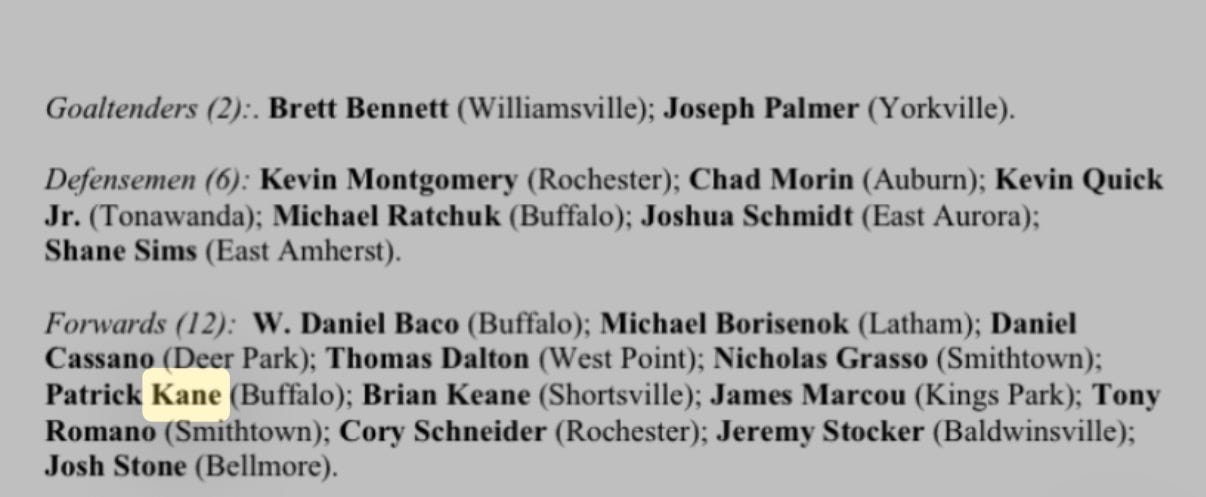
In 2004, Stone and Kane were selected to represent New York at USA Hockey’s Select 16 Festival. The two, who had spent years competing against one another, were now teammates.
I asked Stone what he remembers about that game.
As a two-time New York State champion (2001 and 2003) and 2005 National Championship winner, Stone helped set the blueprint for Long Island hockey players looking to take their careers to the next level, leaving the area to pursue opportunities in prep school and junior hockey.
At the time, Long Island wasn’t necessarily known for producing elite hockey talent. But Stone’s success helped change that perception, showing younger players in the area that opportunities existed beyond Long Island if they were willing to pursue them.
The Islanders Connection
While Stone had the chance to play with and against some of hockey’s biggest names, his connection to the Islanders is an important part of his story.
Stone had the honor and the privilege of being coached by Islanders legends Bryan Trottier and Bobby Nystrom, who helped the franchise win four straight Stanley Cups from 1980 to 1983, while also playing alongside former Islanders forwards Kyle Okposo and Rhett Rakhshani.
At a young age, Nystrom drilled something into Stone’s head that has stayed with him his entire life.
“Never be satisfied.”
Stone will never forget one game.
His team was facing future NHL players like Cam Atkinson and Ben Smith in a highly competitive game, with professional and college scouts throughout the building.
Stone scored five goals, and for a young player trying to make a name for himself, that’s the kind of performance you dream about, especially with scouts watching.
Understandably, Stone was feeling pretty good about himself. But Nystrom saw things a little differently.
“I remember sitting on the bench smiling, feeling pretty good about myself. But Mr. Nystrom saw things differently,” Stone said. “He looked at me and said, ‘You scored five goals, but you had eight shots on net and hit a post. What are you so happy about?’”
You score five goals, and your coach wants to know why you didn’t score more. That’s quite the lesson for a young hockey player.
“That was Mr. Nystrom’s mentality. He always preached, ‘You’re only as good as your last shift.’”
Looking back, he realized Nystrom was teaching him something much bigger than hockey.
“He wasn’t telling me not to be proud of my accomplishments. He was teaching me never to become complacent, never to lose my hunger, and to understand that there’s always another level to reach,” Stone said. “That mindset has helped me tremendously throughout my life, especially when hockey was taken away from me, and I had to reinvent myself, and even in business, that mantra has stuck with me.”
Stone couldn’t have known it then, but that lesson would become even more important when his hockey career came to an abrupt end.
A Brother’s Perspective
While Stone chased his NHL dream, someone else got a front-row seat to everything he accomplished: his younger brother, Troy Stone.
For Troy, growing up alongside Josh meant experiencing a side of hockey that most kids could only dream of.
From watching his brother compete against future NHL stars to meeting some of the biggest names in Islanders history, Troy witnessed just how special those years were.
“Growing up, I got to experience things most kids could only dream about, all because of my brother’s ability to play hockey. I got to watch Patrick Kane go head-to-head against my brother, met Patrick Roy, and be around Bobby Nystrom, my father’s favorite player growing up.
“My dad watched Nystrom win four Stanley Cups with the Islanders, and now here we were, with that same guy coaching my brother. It was surreal. At the time, I don’t think I fully appreciated how special those moments were.”
But as Troy remembers it, the youth hockey world wasn’t always glamorous. Plenty of chaos reigned, especially when parents believed their children were destined for NHL stardom.
“People don’t understand how crazy those hockey days were. You had parents fighting with other parents, parents arguing with coaches, everybody thinking their kid was the next Wayne Gretzky. It was a whole world of its own. But in the middle of all that chaos, my brother was actually doing it. Winning championships, playing against the best kids in the country, and putting Long Island hockey on the map. I had a front-row seat to all of it.”
For Troy, what stands out looking back isn’t just the championships or the players Josh shared the ice with. It’s the impact his brother had on Long Island hockey at a time when the region wasn’t necessarily viewed as a place that produced elite talent.
“When I look back at what Josh accomplished, I don’t think people realize how much of a trailblazer he really was. Long Island wasn’t looked at the way it is today when it came to hockey. I watched him win state championships, a national championship and compete against guys who would become NHL superstars.”
Those are memories Troy will never forget. But neither brother could have imagined just how drastically their lives would change when hockey was suddenly taken away.
The Injury That Changed Everything
Unfortunately for Stone, his hockey dreams ended at 20 after a career-ending shoulder injury.
When you’re a young athlete, you spend years working toward one goal. Every practice, every game, every sacrifice comes with the hope that one day you’ll get the chance to play at the highest level.
For Stone, that dream vanished. What followed was an incredibly dark period in his life.
What made it worse was that while Stone was home trying to figure out his life and find a new purpose, he was watching his friends and former teammates live out the dreams he once shared with them.
It made watching hockey, let alone being involved in the game he loved, too painful.
During that difficult stretch, Stone heard from plenty of people. But few voices mattered as much as Nystrom's.
The same man who had challenged Stone to be better after scoring five goals was still there for him when hockey was no longer an option.
He also received a voicemail from Islanders legend Pat LaFontaine, which he used as the intro to Skit 1 on his first EP as an artist, after years of A&R and producing for other talent. The project “Therapy Sessions” was co-produced by legendary producer Rsonist of The Heatmakerz and charted worldwide on Apple Music, peaking in the top 10.

There’s no sugarcoating what Stone went through. While the injury could be viewed as a blessing in disguise, Stone called it more of a silver lining. It took away something he loved and something he had worked his entire life to achieve.
But while Stone couldn’t change what happened to him, he could control what happened next. And eventually, music helped him find his way forward.
Adversity & A New Beginning
When you spend your entire life building toward one dream, banking your whole future on it, and that dream gets taken away, what do you do? That’s the question Stone had to answer. And it wasn’t an easy one.
“You can’t change what happened.”
Work ethic is something you either have, or you don’t. During my conversation with DOT, one thing became abundantly clear: He has it.
When Stone gets invested in something, he doesn’t do it halfway. That’s how he approached hockey, and eventually, music and life in general.
During those dark times, Stone started getting more involved in music. Not just listening to it, something he had always loved, but learning to create it himself.
Something that began as an outlet during one of the most difficult periods of his life eventually became something much bigger. For the first time since his injury, Stone was beginning to see a light at the end of the tunnel.
The more he learned, the more he recognized that some of the same things that made him successful in hockey could translate into a completely different industry.
The work ethic. The competitiveness. The relationships. The willingness to put in the time when nobody else was watching. And along the way, Stone had some pretty influential people in his corner.
He was mentored by 2013 Rock & Roll Hall of Fame inductee Chuck D, the legendary rapper and co-founder of the revolutionary hip-hop group Public Enemy.
The late Chris Lighty of Violator Management, a prominent music executive who worked with some of the biggest names in hip-hop, including 50 Cent, LL Cool J, Mariah Carey, Missy Elliott, and Busta Rhymes, discovered Stone.
Those relationships helped Stone navigate the music industry as he worked to establish himself in a world much different from the one he grew up in.
For Troy, watching his brother enter the music industry was another chapter in a journey he had been part of since childhood. The same person he once watched compete against future NHL superstars was now navigating an entirely different world, surrounded by some of the biggest names in hip-hop.
And yet, despite how different those two worlds were, Troy saw the same person.
“It’s crazy when I really think about it. I went from watching my brother compete against some of the best hockey players in the world as a kid, traveling to tournaments and watching him win championships, to standing next to that same person in the middle of Harlem at midnight next to Jim Jones, working in a completely different world of hip-hop. Two completely different environments, two completely different chapters of our lives but the same guy with the same mentality. If Josh is going to do something, he’s going all in. That’s just who he’s always been.”
Whether it was hockey or music, Stone wasn’t interested in simply participating. He wanted to succeed.
Stone wasn’t chasing the NHL anymore, but he was still chasing something. And this time, he was determined to build it himself.
From Hockey Dreams To Building Something Bigger
That determination eventually led Stone to create two companies: Icy Ventures and Real Vibez Only.
Icy Ventures operates across talent management, entertainment, sports, music, fashion, culture, and strategic partnerships. Real Vibez Only is an entertainment company and independent record label built to challenge industry norms.
Two different brands, but both reflect who Stone has become and the relationships he’s built since his playing career ended. And while his playing career was over, his hockey story was far from finished.
In fact, one of the most interesting parts of Stone’s journey is where those two worlds have brought him today. The kid from Bellmore who once dreamed of reaching the NHL is now operating at the intersection of hockey, music, entertainment, and culture.
Through Icy Ventures and the relationships he’s built in entertainment, Stone has found his way back into hockey, helping connect the sport with audiences outside its traditional fan base.
That includes working on entertainment-related events involving the Islanders. His work has helped bring entertainers and artists into the Islanders’ world, including Jericho native Madison Beer, rapper Bobby Shmurda, and actor Kenan Thompson.


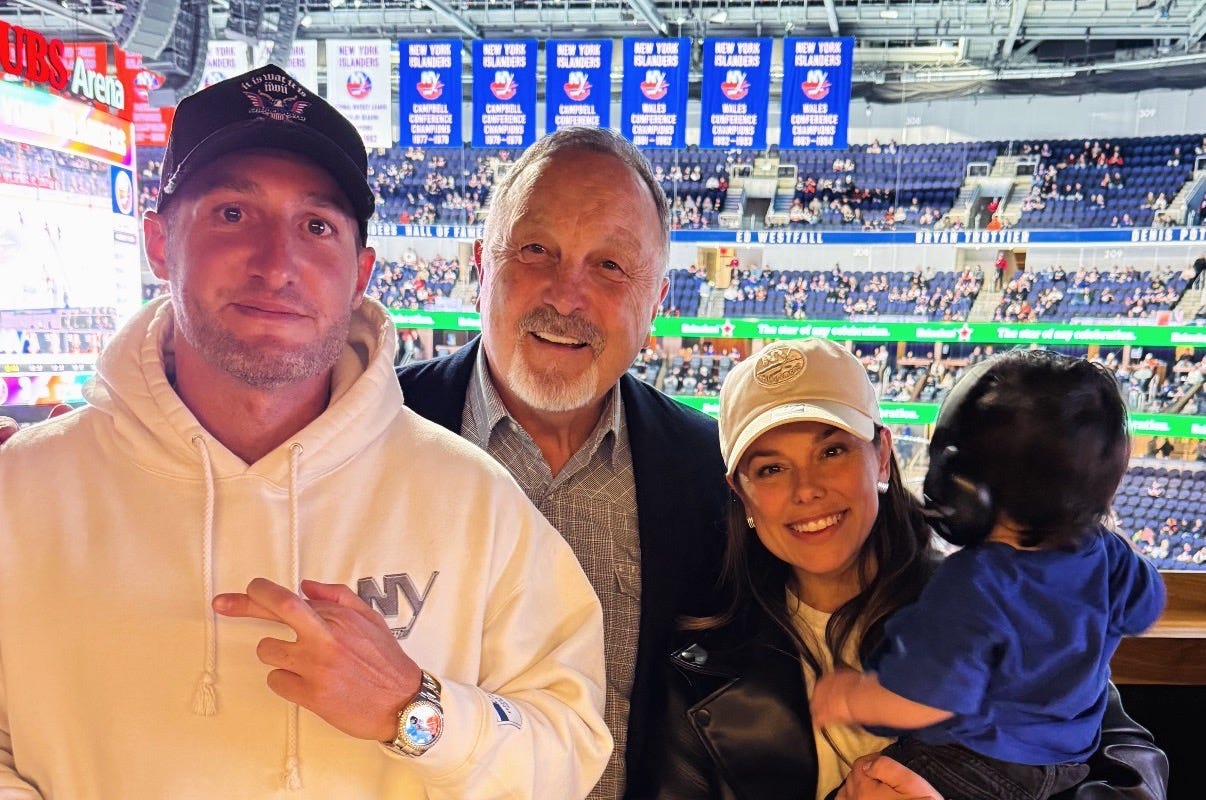
During Kenan Thompson’s visit to an Islanders game against the Anaheim Ducks, a fitting appearance given his role in The Mighty Ducks films, I had the opportunity to spend time in co-owner Jon Ledecky’s suite.
There, I was reintroduced to Stone, whom I first met at Brandon Bussi’s Stanley Cup celebration along with his brother Troy. I was invited via Bussi’s agent, John Kofi Osei-Tutu, a former teammate and longtime friend of Stone’s, who introduced us.
What stood out to me that night was just how invested Thompson was in the game and how fascinated he was by the Islanders’ history.
As he looked around at photos and memorabilia from the team’s dynasty years, when they won four consecutive Stanley Cups from 1980 to 1983, he kept asking to take pictures in front of different displays.
It was pretty cool to see someone with his entertainment background take such a genuine interest in the Islanders and what the franchise accomplished.
When Stone wasn’t hanging with Kenan and Shawn McGee of G Unit Management, he was speaking with Islanders co-owner Jon Ledecky and team president Kelly Cheeseman. These weren’t just casual conversations. They were important discussions about Stone’s ambitions and what he hopes to accomplish moving forward, particularly when it comes to bringing his experience in music and entertainment into the hockey world.
For Stone, bringing people from the music and entertainment industries into the hockey world is about more than simply having a celebrity attend a game. It’s about connecting different communities and introducing the sport to people who might not otherwise follow it.
For a kid who grew up dreaming of making his own mark in hockey, it’s something pretty special to contribute to the game’s growth in an entirely different way.
Something else caught my attention during my conversation with Stone. If you look closely at his pictures, you’ll notice he often has his fingers crossed.
Naturally, I wanted to know what that meant.
“Signing to those who know the codes culturally,” Stone said. “These are my people. Don’t play with them.”
It reflects how important relationships and loyalty are to Stone. Those values mattered to him as a hockey player, and they matter just as much today.
Coming Full Circle
I wanted to end our conversation by talking about someone very important to Stone: his son, Leonidas, and his wife, Joanna.
Stone and his wife recently brought their son to his first Islanders game against the Anaheim Ducks on Oct. 20. Think about how much had to happen for Stone to reach this moment.
The kid from Long Island who once dreamed of reaching the NHL saw his hockey career end at 20 due to injury.
After struggling to find his purpose, Stone turned to music, building a successful career and relationships that eventually brought him back to the game he once struggled to watch.
Now, years later, he’s getting to share that same game with his son.
Leonidas can learn a lot from his father’s journey. Not every dream works out the way you envision it.
Sometimes, no matter how hard you work or how badly you want something, circumstances beyond your control change everything.
But that doesn’t mean your work was for nothing.
Stone never reached the NHL as a player, but the lessons he learned through hockey helped him build a life beyond it. And now, he’s helping grow the very game that once meant everything to him.
When his brother Troy looks back on everything they’ve been through, he thinks about something the late rapper Nipsey Hussle once said.
“Nipsey Hussle said something that always stuck with me: ‘We went through every emotion.’ And when I think about my relationship with my brother, that’s the absolute truth,” Troy said. “We’ve experienced every high, every low and everything in between. I’ve seen him on top of the world and I’ve seen him at his lowest. We’ve celebrated wins together, dealt with losses together and had to figure things out when nothing was going our way. There’s a lot of history between us that people will never see or fully understand. But that’s what makes our bond what it is. My brothers keeper.”
It’s a powerful reflection on everything the Stone brothers have experienced together. And a reminder that Josh’s story has always been about more than just hockey.
I keep coming back to something Nystrom told Stone all those years ago.
“Never be satisfied.”
At the time, it was a lesson about scoring five goals and still wanting more. Today, it means something entirely different.
Stone’s playing career ended long before he wanted it to, but his story didn’t. And that’s something worth passing down to the next generation.