




ELMONT, NY — The New York Islanders may have found the best version of their top line in Mathew Barzal, Bo Horvat and Simon Holmstrom.
But there’s a way for Islanders head coach Pete DeBoer to make that line even more dangerous.
His name is Matthew Schaefer.
Happy Free Friday!
In the Islanders’ 3-2 shootout win over the St. Louis Blues on Wednesday night, DeBoer decided it was time to reunite Barzal and Horvat, a duo that had worked wonders in the past.
Given the way Holmstrom's play, the trio had the potential to do a lot of damage.
While there were flashes of what that line could become, the offensive production wasn’t there.
None of the three forwards recorded a point at 5-on-5, although Horvat recorded the secondary assist on Victor Eklund’s 6-on-5 goal with 2.3 seconds remaining in regulation to force overtime.
But a deeper dive into the top line’s shifts tells an interesting story about how important No. 48 is to their ability to generate offense.
DeBoer and his coaching staff seemed to recognize that as the game went on.
Schaefer’s Deployment Against St. Louis
Schaefer played 31:35 against the Blues, with 23:10 of that coming at 5-on-5.
Using the NHL’s official shift data, here’s how much time Schaefer spent with each forward line at 5-on-5:
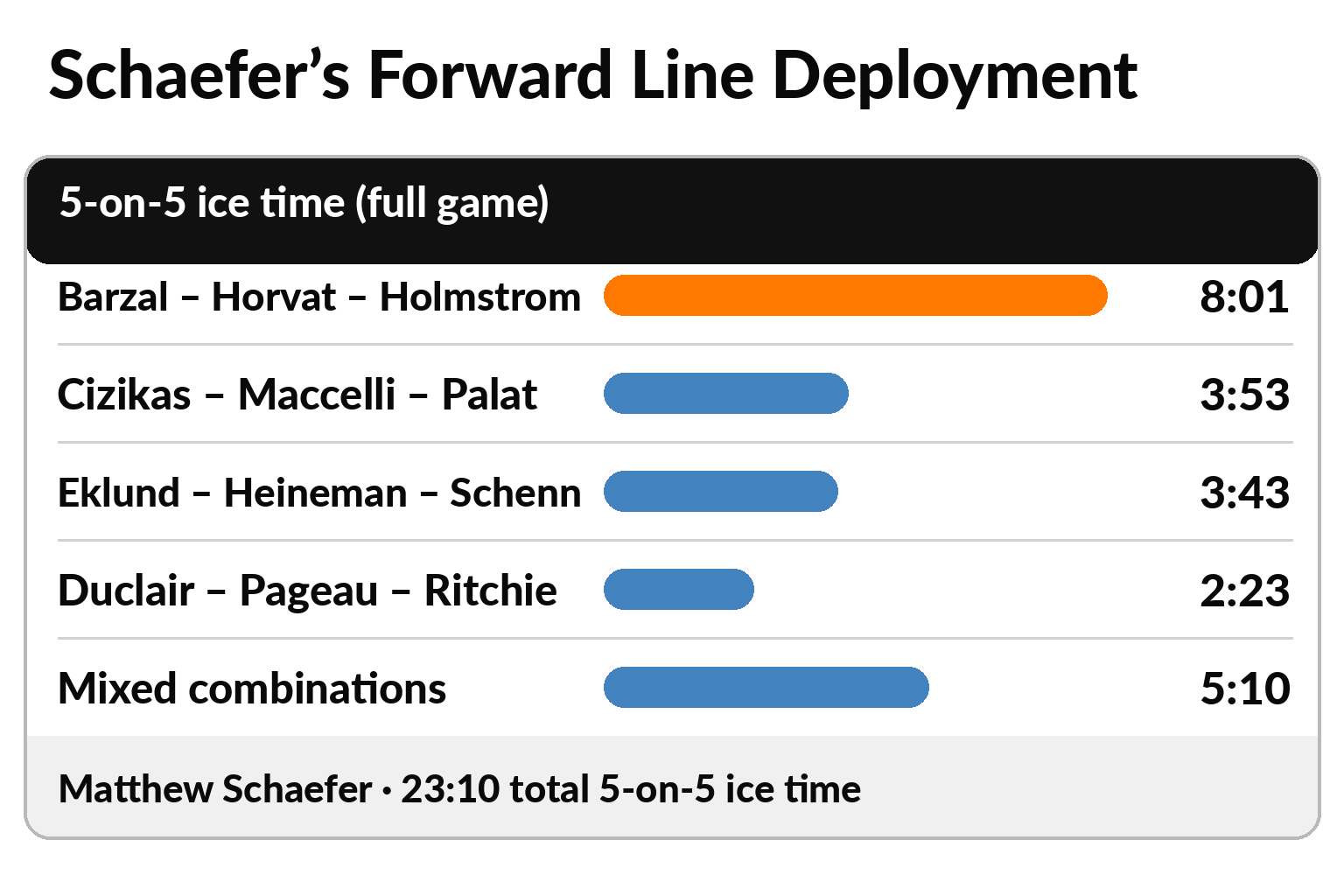
It seems that whenever defense coach Bob Boughner could get Schaefer out there with the top line, he did.
However, that wasn’t the case early on.
In the first period, Schaefer spent more time with Casey Cizikas’ line than with Horvat’s. Part of that can be attributed to the Cizikas line and the Pelech-Schaefer pairing starting the game.
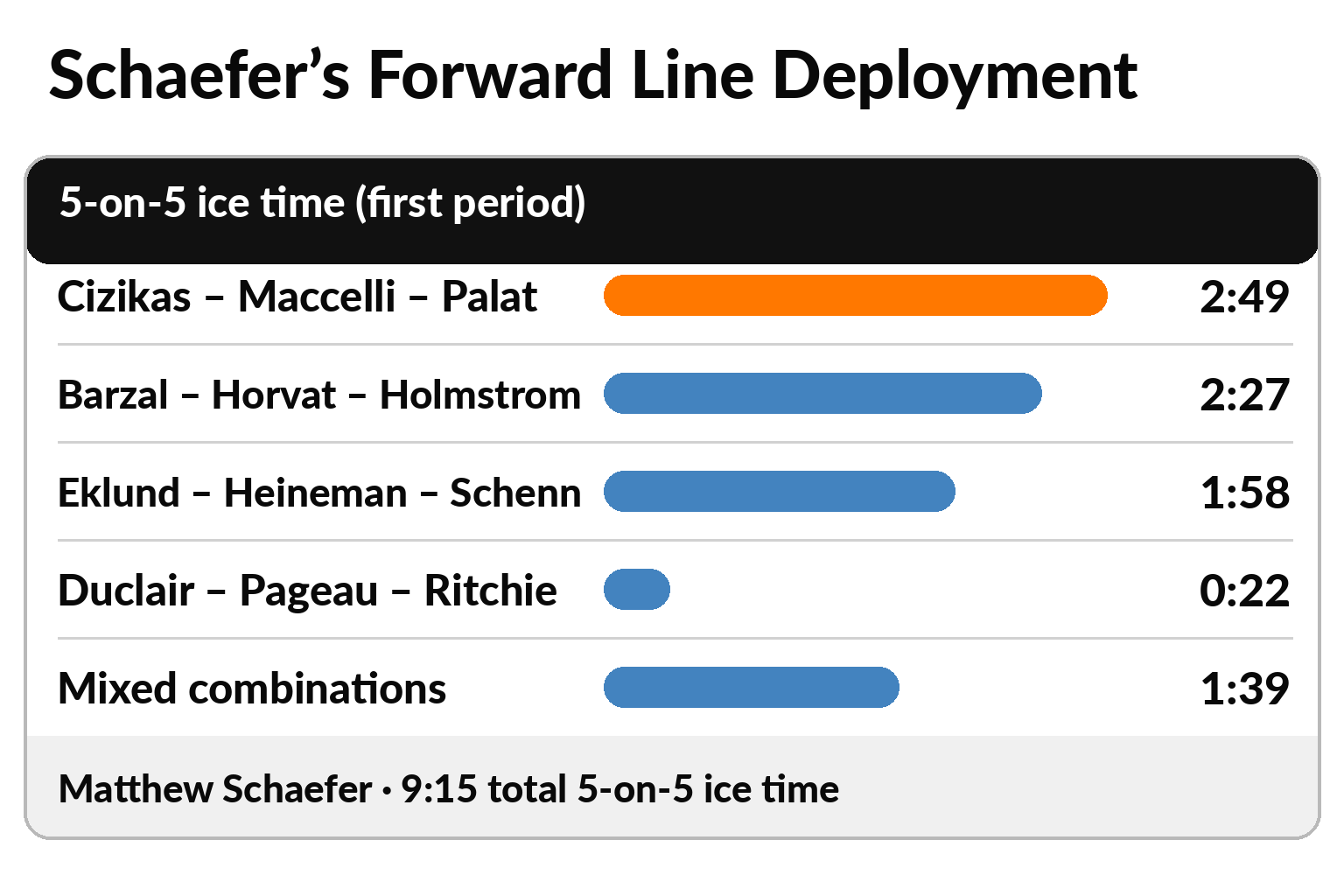
The Horvat line had seven shifts together in the opening frame, four of which came entirely without Schaefer.
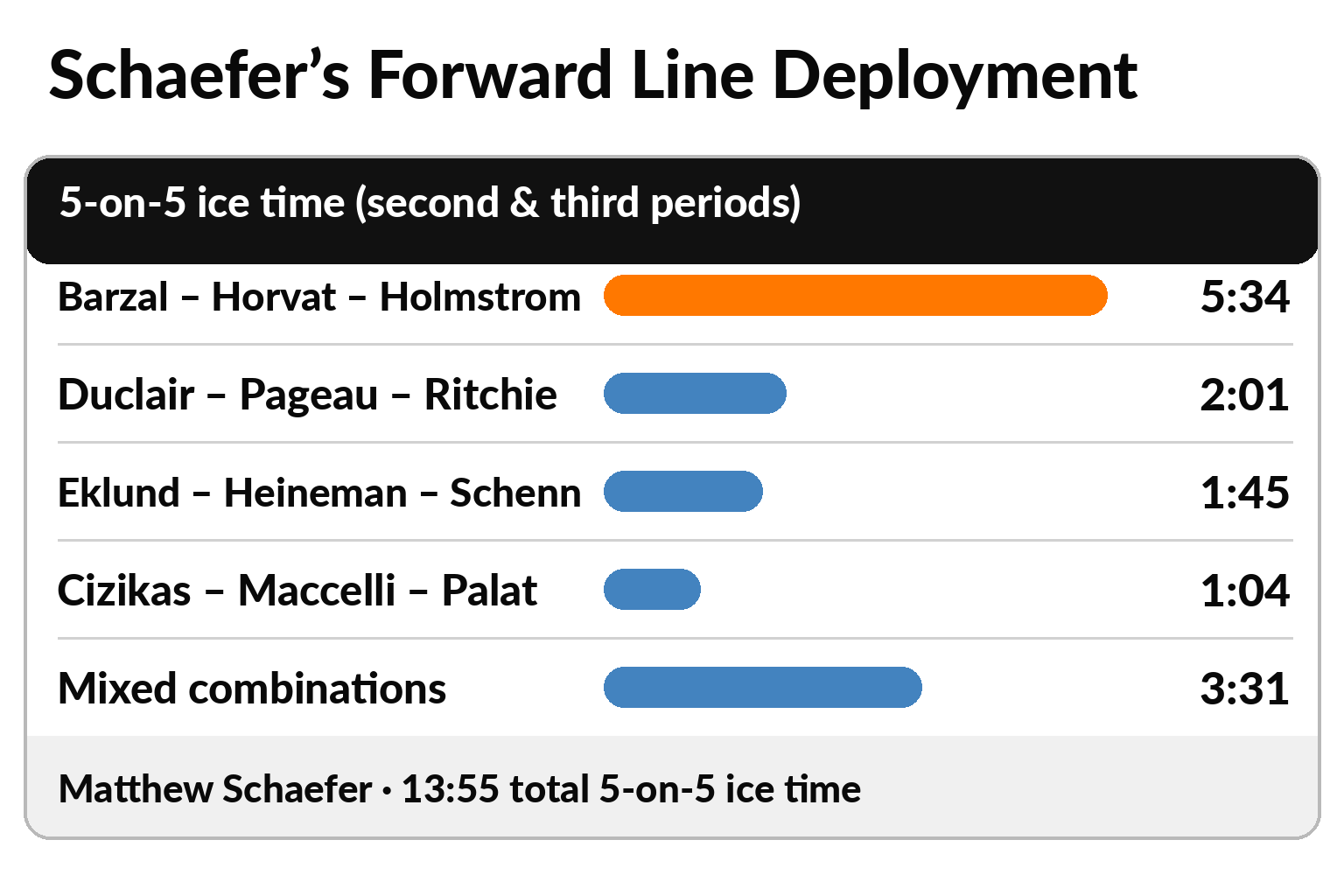
As the game progressed, Schaefer was used more and more with the top line. For the remainder of regulation, Schaefer was on the ice for at least part of 11 of their 14 shifts together.
Now, why does that matter?
What The Numbers Tell Us
Almost every time the Islanders’ top line took the ice without Schaefer against St. Louis, they found themselves hemmed in their own defensive zone.
We know what Schaefer’s ability to retrieve pucks, escape pressure, and transition up ice means for the Islanders as a team. But when you have three forwards with the offensive skill sets of Barzal, Horvat, and Holmstrom, getting the puck into their hands quickly matters even more.
Here were their offensive numbers at 5-on-5 with and without Schaefer:
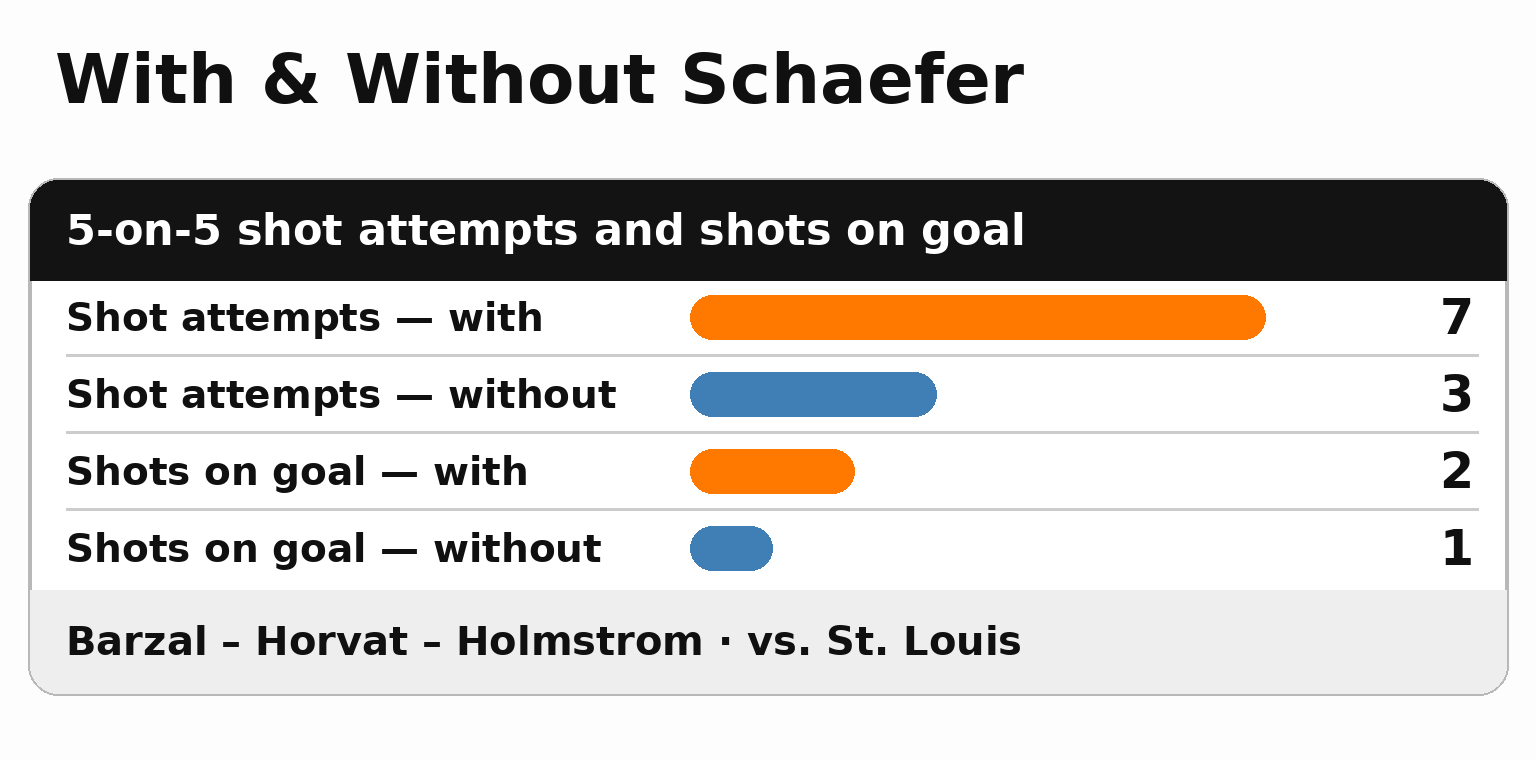
The lone shot on goal that the trio generated without Schaefer came off Barzal’s stick in the third period.
It’s a small sample size, no question, but when you watched the game and saw how hard it was for that line to get going offensively without Schaefer, the numbers made sense.
What Schaefer Had To Say
Following the game, I asked Schaefer about getting the opportunity to play with those three.
“Anytime Boogie [Boughner] gives you the call when you’re up, you always look to try to get some offense or defense, whatever you can do to help out the team,” Schaefer told The Elmonters. “But for me, I like when I can just get out there and start flying around. It’s fun when you’re working with guys that are the same speed. I mean, it’s always fun to work with everybody.
“It’s fun when you can get out there, and you can start flying around, and sometimes you can’t even control yourself when you’re just flying around out there trying to make plays. It’s fun when you can just go out there and use your chemistry to build with each other. “
The Islanders need to give those four more opportunities to build on what we saw Wednesday night.
How DeBoer Can Maximize His Top Line
The hard part for DeBoer is that every forward line benefits from having Schaefer out there.
But what makes it easier for the Islanders to be more calculated with Schaefer’s deployment is that he isn’t tied to one defense partner.
While Adam Pelech remained his primary partner, Schaefer played alongside every other Islanders defenseman at 5-on-5 against St. Louis:
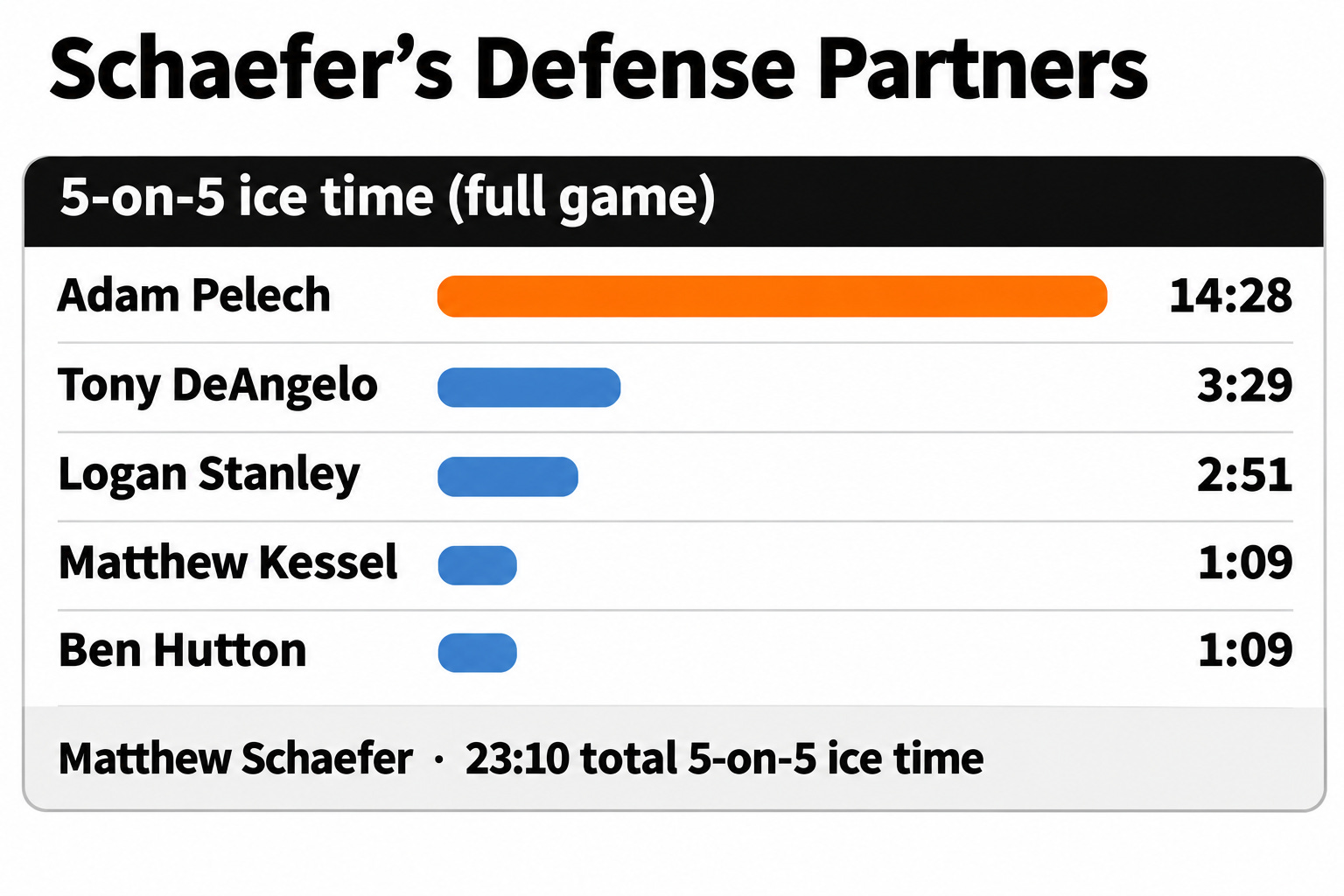
That gives Boughner more flexibility to get Schaefer out there with Barzal, Horvat and Holmstrom without having to wait for the Pelech-Schaefer pairing’s next turn in the rotation.
Of course, the Islanders need Schaefer to help generate offense throughout their lineup, so the answer isn’t to play him exclusively with those three.
But if DeBoer believes Barzal, Horvat and Holmstrom are his most dangerous forward combination, shouldn’t the coaching staff make a concerted effort to get No. 48 out there with them as often as possible?
“Listen. [Schaefer and the top line] made some plays,” DeBoer said postgame. “They got some looks. I liked all our lines tonight, and we’ll keep working at those groupings until we consistently start getting some things that really make sense. But there were some really good signs tonight.”

