



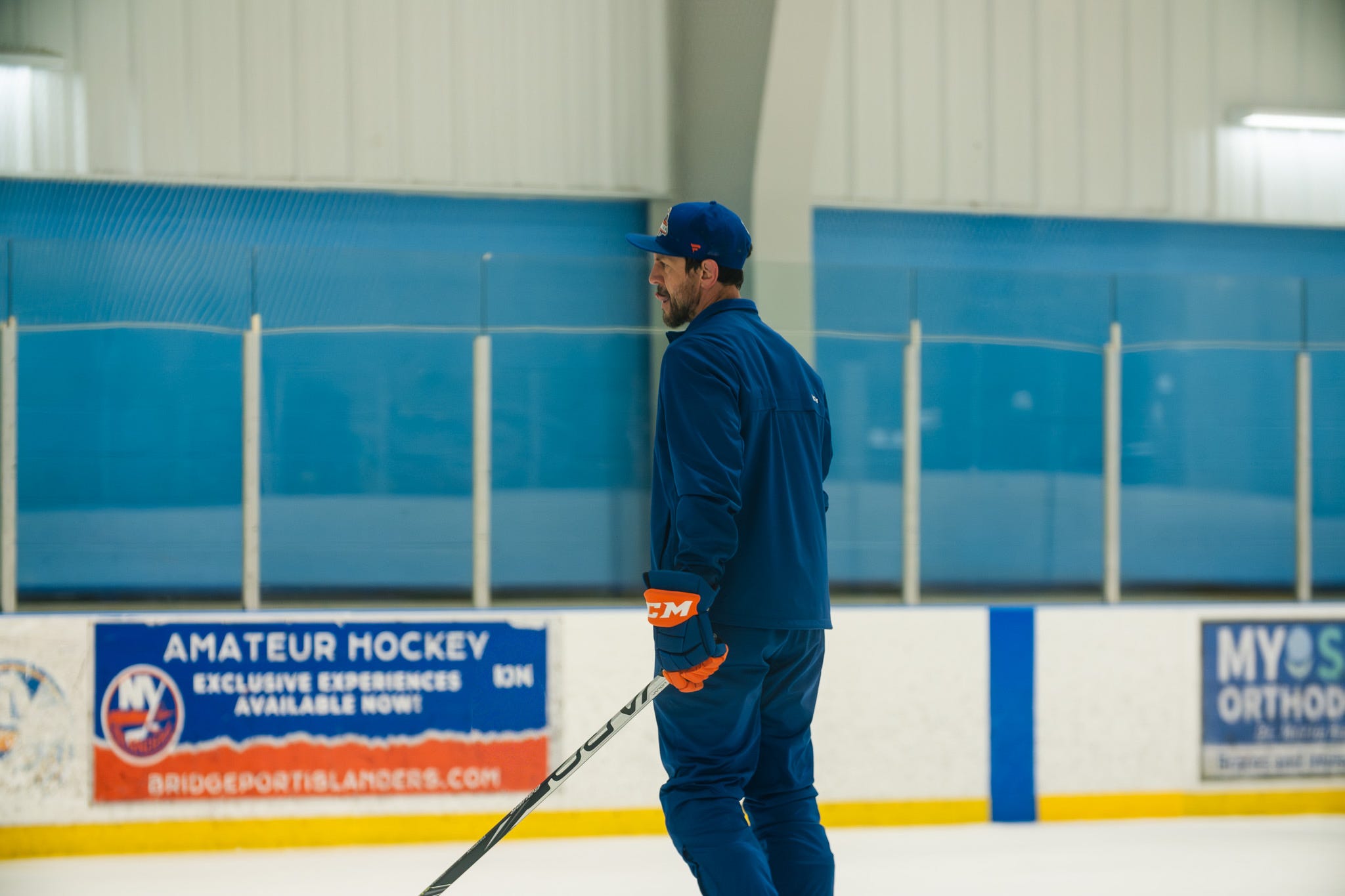
BRIDGEPORT, CT — When we spoke with Rocky Thompson during his introductory press conference after being named Bridgeport Islanders head coach, he dropped a line for the ages.
“We aren’t going to be the punching bags anymore.”
That’s what Bridgeport had become, but with the prospect pool taking tremendous strides over the last two seasons and many of those top names coming over to the organization over the next two years, quickly changing the culture was paramount.
EXCLUSIVE INTERVIEW: How Rocky Thompson Is Driving A Culture Shift In Bridgeport

This summer, New York Islanders general manager Mathieu Darche put his faith in Rocky Thompson to revamp the culture and identity of the Bridgeport Islanders.
However, it’s easier said than done. But credit to Thompson, because he’d done it in his first season, the AHL affiliate’s final season in Bridgeport, getting them back into the postseason for the first time since 2021-22.
Here’s my chat with Thompson about how he turned Bridgeport around, plus some insight on the organization’s rising stars:
Stefen Rosner: First off, I love what you did with the place. When we first spoke with you, you said, ‘We aren’t going to be punching bags anymore.’ When did you see the team really embrace that mentality? Is it from day one or built over the course of the season?
Rocky Thompson: “It was a process. They were a fragile group last year. Every day, our goal was to get better than the previous day. And then, just start to instill the culture, instill the hard work, determination, and perseverance. That isn’t something that happens overnight. There’s been ups and downs over the season. Even when you are a team that finishes first in the division. You are going to have adversity. So, we probably faced a little bit more than some teams early on. The guys learned how to deal with it. They learned how to get better and they continued to practice hard. Now you are starting to see the results of all of that hard work. I wasn’t easy on them. I was hard on these guys. We have good leadership who took it the right way, to make themselves better as individuals, but, most importantly, to get the team where it needed to be so we could be competing for a playoff spot.”
Stefen Rosner: You talk about the team being a fragile group. Did you have to check yourself sometimes with how hard you were on the guys, in fear that maybe that being too hard could have the opposite effect you were looking for?
Rocky Thompson: “The opposite. I would come in and say, ‘Am I being too hard?’ Because you can only do it so much. And I felt, at the end of the day, with the staff, if I let off the gas, then we would have crumbled. I had to push it even further than maybe even I felt a little comfortable with myself, more than I’d been in the past, because they needed it. It is a double-edged sword. Sometimes it can be too much, and so we were trying our best to keep the pressure on that way, without going overboard. And we were able to find a balance this year. And it’s different with every group. You've got to be willing to change and adjust. And so it was a constant conversation so that we could obviously help them the most that we could.”
Stefen Rosner: How much did you rely on the leadership group, like Chris Terry, to help get your message across?
Rocky Thompson: “I was hard on him. He sat out for large stretches. He’s earned his way back into the lineup, so it speaks to his leadership. Because sometimes a veteran, when they get to that point — he wasn’t a part of this at one point — he never changed his attitude. He was good. He knew he needed to be better. He had to work. And it was an excellent example for the other group that if somebody like Chris Terry is getting sat out and has to get better, well, they saw how he dealt with it, and so there’s no greater form of leadership than how he dealt with that own personal adversity. It’s not just saying the right things in the room. It’s actually living and experiencing it, and for them to experience him go through it, and how he dealt with it, there’s no higher form of leadership than that. I give him tons of credit.”
Stefen Rosner: You have so many guys here. How do you balance rewarding the guys you’ve dealt with and seen grow this season while also playing the guys coming down from the NHL for the playoff push?
Rocky Thompson: “Best man for the job.”
Stefen Rosner: What have you seen from Victor Eklund since he’s come here?
Rocky Thompson: “Well, he’s done a good job. Yeah, he's getting comfortable out here, and he has a skill set that we didn’t have this year. There’s a niftiness to his game, but there’s a real big competitiveness to his game as well. And that’s why you can see they picked him where they did, and he’s a good kid, and he wants to learn. And so, yep, it’s a good opportunity, and it’s a good experience for them to get into this fight and see what it’s like.”
Stefen Rosner: What does it say about the culture in Bridgeport now that a lot of guys like Eiserman, like Eklund, guys that could have waited until next season or the season after, wanted to come and play?
Rocky Thompson: “There’s the right culture here. People want to be a part of it now. And our guys did the impossible. They got fans to want to come and watch us play again, and they did a great job with that, because of what they were doing on the ice and the heart and soul they were putting into it every night. And we didn’t get the rewards early. Our record wasn’t anything special. We were under .500, we were losing games, but we competed every single night. We gave everything we had, and as we did that, we incrementally got better. And the fans appreciate it. The fans wanted to watch it, and then success started to come. And so that’s a contagious thing. And when you’re on the outside looking in, you’re like, ‘I want to be a part of that.’ When you’re not in the lineup, you’re like, ‘What do I have to do to get in. When I get in, I can’t come out. I have to be better when I’m playing.’ It’s not about practice. You've got to work hard no matter what. What are you doing during the game that warrants you to stay in the game? And you just look at our roster throughout the year. These guys weren’t injured. They were sitting out because we didn’t do that, and they learned how to do it. And yeah, so I give them a ton of credit, because they’ve done it the right way, the way you’re supposed to, is the old-fashioned way. You get what you deserve.”
Stefen Rosner: What do you think Cal Ritchie gets out of this, coming back down for the playoffs?
Rocky Thompson: “This is huge. There’s a great example: Protas, who is with Washington. He played almost two full seasons in the NHL. Then they sent him down, and then he won a championship. You learn, and you experience things. Playoffs is a whole different animal. It’s a different style of game. I just talked to these guys. Just turn on the television tonight. Those are different teams that are playing. They’re physical guys who never threw a hit all year long. It’s a whole different element, and you've got to experience it at this level, to know what you’re getting into when you’re fortunate enough, if you’ve been blessed enough, to have the opportunity at the next level. And so it’s a great experience and opportunity for him and the team. A lot of these guys have never played in the playoffs.”
Stefen Rosner: The outside noise around Cole Eiserman is that he’s a one-trick pony who doesn’t have a two-way game. From watching, it looks like he’s taken strides in that area.
Rocky Thompson: “That’s something that we’ve got to work on with him. And he’s a hard worker. He really is. He wants to be better. He just never did it. And so to expect somebody to all of a sudden do it, it’s not an easy thing. It looks to me that he didn’t have to be responsible in those areas, and with us, he has to be responsible. I’ve been very hard on him, too. And again, he’s a good kid. He’s seen that that’s the culture here and that that’s what’s required of him. And so we got to round out his game, and that’s going to be a process. It’s not something that happens overnight, but he does have a very specific skill set, which has helped us already, and that’s why he’s got as many points as he had. The American League is not easy to generate points, and he’s done a very good job of that offense. We just got to keep hammering home the defensive responsibilities of him, and that’ll ultimately feed more offense into his game.”
EXCLUSIVE: Islanders Prospect Cole Eiserman On His Two-Way Growth During Bridgeport’s Playoff Push & Life In The AHL

BRIDGEPORT, CT — New York Islanders’ 2024 first-round pick (No. 20) Cole Eiserman could have returned to Boston University for his junior season.