



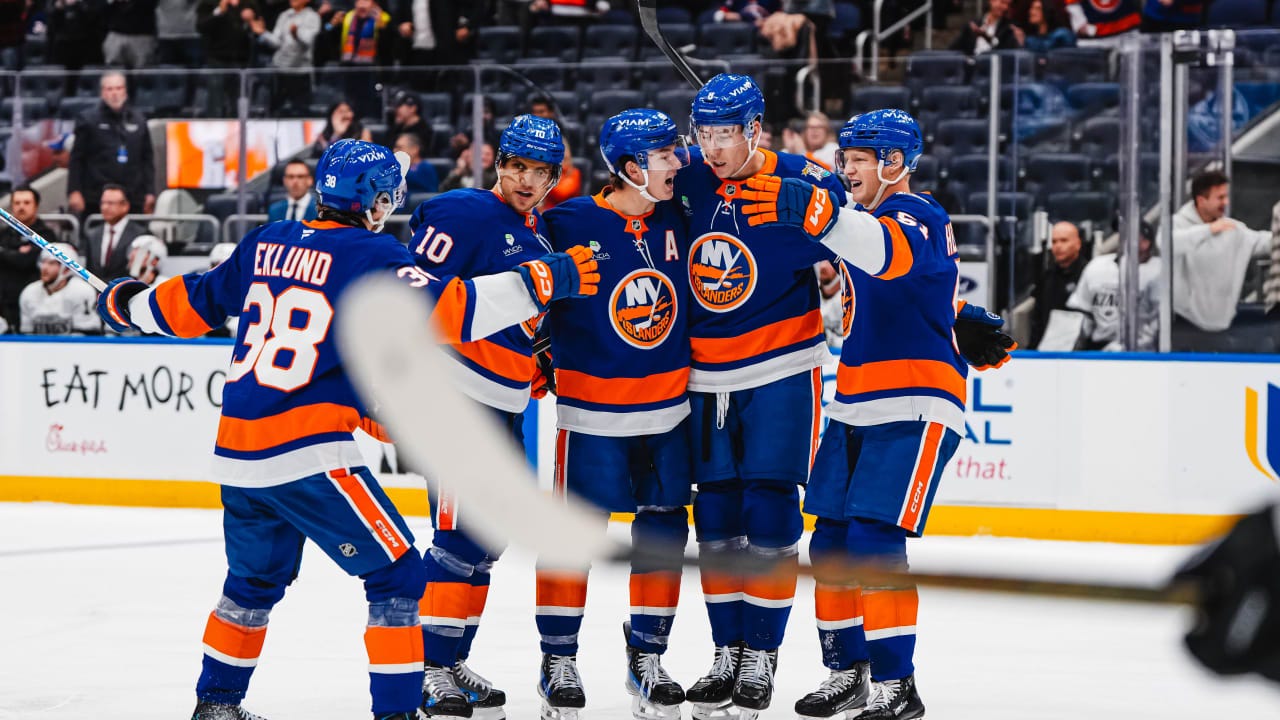
ELMONT, NY — Through the first 10 games of the 2026-27 season, the New York Islanders own a 5-3-2 record (12 points), sitting third in the Metropolitan Division.
And while there’s still a long way to go, there’s been plenty to talk about in what we’ve seen from Pete DeBoer’s group.
The Islanders have shown significant improvements in their structure, have gotten strong performances from key players, and have found ways to earn points even when things haven’t gone their way.
The Barzal Situation, And Learning From Experience

ELMONT, NY — Many have spoken about Mathieu Darche’s comments on Mathew Barzal’s injury.
But there are still areas that need improvement, particularly when it comes to finishing their scoring chances.
With 10 games in the books, let’s dive into 10 things we’ve learned about the Islanders so far this season.
Happy Free Friday!
Pete DeBoer’s System Works
DeBoer told us at the start of the season that it could take months for his team to master his system. But over 10 games, the Islanders have worked out some kinks early and locked in on what’s being asked of them.
Everyone, every line, has a job to play, and it’s about establishing the forecheck early, with Casey Cizikas entrusted to start games. He’s been an underrated piece in this puzzle.
It’s one thing to know the system, but another to execute it. And the passes have been crisp, whether cycling in the offensive zone or transitioning. Their play through the neutral zone and right at the opponent’s blue line has been impressive.
On the flip side, their recoveries back into the defensive zone have tightened, forcing aggressive dump-ins. They’ve allowed the 10th-fewest shots in the league and have the 13th-highest expected goals for at 5-on-5 (21.61).
They’ve scored 19 goals at 5-on-5.
And that takes us into the next point.
The Islanders Still Need A Goal Scorer
The Kings game was a perfect example of not having enough finishers on their roster.
They took 39 shots on goal and passed up looks, but couldn’t beat Darcy Kuemper, who kicked out juicy rebounds left and right.
Credit to him for making the secondary and tertiary saves, but he was beyond beatable last night.
And listen, Bo Horvat is a great shooter, but you need more than one guy who can deposit pucks when he isn’t.
Dallas obviously isn’t trading away Jason Robertson this season, regardless of his contract status. But given how well Robertson played under DeBoer, he’s probably at the top of your list this summer, depending on how DeBoer feels about him.
Cole Eiserman isn’t ready yet,, so they’ll need someone else if they want to get the most out of the chances being created.
The Logan Stanley Signing Is Paying Dividends
When the Islanders signed Stanley, the organization expected him to play with Tony DeAngelo on the third pair.
But just two games into the season, Alexander Romanov tore his ACL, forcing the defense pairs to change.
DeBoer put Stanley with Schaefer, and it’s been ultra-effective.
Yes, it’s easier to be more effective with Schaefer on the ice, but Stanley has been strong in front of the net and in the corners, getting the puck to Schaefer and being ready to stand up for any teammate who needs it.
The Schaefer-Stanley pairing has the second-lowest expected goals against (4.2) among 41 defense pairings that have played 90 or more minutes together at 5-on-5.
He’s also been dominant on the penalty kill, averaging 20:40 total minutes per night, a new career high (17:12 ATOI in 2025-26).
Semyon Varlamov Is A Work In Progress
After missing nearly 23 months following two partial knee replacements, no one would have expected Semyon Varlamov to return and immediately look like the goaltender he was before getting hurt.
There’s going to be some rust, and we’ve certainly seen that through his two starts. His positioning is off, and he’s getting beat high glove side extremely often.
He’s shown flashes of the old Varlamov, helping the Islanders earn points in each of his two starts.
Now, does he need to be better? Absolutely. He owns an .899 SV%, but his 2.25 GAA is extremely strong.
The Islanders don’t need Varlamov to be Ilya Sorokin. They need him to give them a chance to win games while allowing Sorokin to get the rest he needs throughout the season.
Pete DeBoer has made it clear that he wants to get Varlamov into games regularly, whether that’s once a week or every 10 days.
And I think that’s critical.
The only way for Varlamov to get back into a rhythm is by playing games. Practice can only do so much, especially for a 38-year-old netminder who’s missed so much time.
The Islanders need to be patient with Varlamov, but they also need him to find his game sooner rather than later.
Bo Horvat Getting The “C” Was A Slam Dunk Move
When the Islanders named Bo Horvat their 16th captain in franchise history, we knew what he brought to the table as a leader.
But what we’ve seen early this season shows just how important he is to this group.
Through 10 games, he has five goals and five assists. But the points are just part of the equation.
Horvat is doing everything the Islanders need him to do, whether that’s scoring big goals, winning critical face-offs, playing significant minutes on the penalty kill, or leading by example.
When the Islanders lost Cal Ritchie and Matias Maccelli against the Toronto Maple Leafs, Horvat played 24:21, scoring a goal and getting an assist in a 4-1 win.
That’s what a captain does.
And while we’ve seen Horvat lead by example since arriving on Long Island, I think wearing the “C” has brought another level out of him.
He’s not asking his teammates to do anything he isn’t willing to do himself.
We’ve talked about the importance of everyone pulling on the same rope, and Horvat is leading the charge.
His teammates respect him, and it’s clear that DeBoer trusts him in every situation.
There’s no question about whose team this is from a leadership standpoint.
Victor Eklund Is Ready To Be A Full-Time NHLer
I’ve been pretty clear about where I stand on Victor Eklund.
If he was going to play in the NHL this season, he needed to be in a position to get meaningful minutes and develop his game.
And if that wasn’t going to happen, I thought he’d be better off playing top-six minutes in Hamilton.
But what we’ve seen from Eklund early this season has made one thing clear.
He’s an NHL player.
It’s not just the offensive production. He’s scored in back-to-back games and has four points (three goals, one assist) in 10 games.
It’s his hockey IQ, his willingness to go into the dirty areas, his ability to win puck battles despite his size, and, more importantly, his impact on the game without needing to score.
With the Islanders dealing with injuries up front, Eklund has earned a chance to take on a bigger role.
He still has plenty to learn, and he'll make mistakes. That’s part of developing in the NHL.
But there’s a difference between a young player just trying to survive at this level and one already finding ways to make a difference.
Eklund is doing the latter.
Matthew Schaefer Is A Long-Term Fit On The Right Side
When the Islanders drafted Matthew Schaefer first overall in 2025, they knew they were getting a stud.
One of the biggest things we’ve learned is that Schaefer doesn’t have to play on his natural side to be effective.
We’ve seen him play on the right side all season, and he’s looked comfortable doing it.
That’s significant for an Islanders team that already has Adam Pelech and Alexander Romanov on the left side when everyone is healthy, along with an extremely bright LHD prospect pipeline.
Through 10 games, Schaefer has a goal and nine assists, averaging 26:13 minutes per night.
But when you’re building a defense for the present and future, a player of Schaefer’s caliber who can play both sides gives DeBoer and Mathieu Darche a ton of flexibility.
It’s not just his skating that allows him to make that transition. It’s his awareness, his ability to read plays, and his confidence with the puck.
This Power Play Can Be Effective
The Islanders have scored six goals on 30 opportunities this season, good for 20%.
Rocky Thompson and Co. move the puck much faster, and the guys are rotating, which has given opponents’ penalty kills issues.
And a big part of that is Schaefer.
His ability to move the puck, walk the blue line, and make quick decisions has given the Islanders a different look with the man advantage.
We’ve already seen how important he’s been to their early power-play success.
But it’s not just Schaefer.
The Islanders are getting bodies to the net, moving the puck with more purpose, and creating opportunities instead of just passing it around the perimeter.
And that’s what a power play needs to do.
Looking at the personnel, they have enough talent to run an effective power play. We’ve known this.
Does that mean they’ll have a top-five power play in the NHL?
No. But they don’t need to.
They need a power play that makes teams pay for penalties, especially on nights when offense is hard to come by at 5-on-5.
Even if they don’t score, the Islanders need their power play to create momentum, and it has.
The biggest question now is consistency.
This Team Doesn’t Quit
I think this has been one of the most encouraging things about the Islanders early this season.
They don’t quit.
We’ve seen them fall behind, deal with injuries, and face moments when things could have gone the wrong way.
But they continue to battle. And I think that’s a testament to the buy-in we’ve seen under DeBoer.
This group has confidence and belief in the system to stay the course, even when things look bleak.
Even when they aren’t getting rewarded on the scoreboard, they stick to their structure, keep pressuring the opposition, and trust that their chances will come.
Thursday’s game against the Kings was another example.
Despite trailing, the Islanders stuck with it and found a way to earn a point against a team that made it difficult to generate offense.
Now, battling back and earning points is great, but the Islanders also need to find ways to win those games.
They can’t rely on coming from behind every night.
But to build a winning culture, you need a group that believes it can win regardless of the situation.
And right now, the Islanders are showing that belief.
It’s one thing for a coach to preach resiliency and playing a full 60 minutes. It’s another thing for the players to actually do it.
Ilya Sorokin is playing at a Vezina-caliber level
I think we all knew what the Islanders needed from Ilya Sorokin entering this season.
He needed to be their best player. And so far, he’s been exactly that.
After finishing last season as a Vezina Trophy finalist, Sorokin has picked up right where he left off, owning a 1.72 GAA and a .934 SV% with one shutout.
His 7.8 Goals Saved Above Expected at all strengths is the best in the NHL.
And I think what’s been most encouraging is that the Islanders aren’t asking Sorokin to bail them out nearly as often as they did last season.
The defensive structure in front of him has improved, and that’s letting him play his game without facing an overwhelming number of high-danger chances every night.
Now, does Sorokin still need to steal games from time to time?
Absolutely.
That’s what elite goaltenders do. But the Islanders can’t expect him to be their entire defensive system.
Under DeBoer, we’re seeing a team that’s doing a much better job supporting its goaltenders.
The biggest thing now is making sure they don’t overwork him.
That’s why getting Varlamov back into a rhythm is so important.
If the Islanders can keep Sorokin fresh all season while improving play in front of him, he has no reason not to be in the Vezina conversation again.


