




Former New York Islanders forward Brock Nelson has won gold with Team USA, exactly 46 years after his uncle, Dave Christian, won gold in 1980, and 66 years after his grandfather, Bill Christian, and great uncle, Roger Christian, won gold at the 1960 Winter Olympics.
Nelson was tremendous in the tournament, playing a huge part on the penalty kill, which went a perfect 18-for-18, adding two goals and one assist centering Team USA’s fourth line.
While an Olympic fourth-line role isn’t usually a typical NHL fourth-line where grit and forecheck are the name of the game, that’s how Team USA head coach Mike Sullivan elected to use his bottom trio of Vincent Trocheck, Brock Nelson, and J.T. Miller, with Clayton Keller also a piece of that puzzle.
But how did Nelson get here? How did the young buck that the Islanders drafted 30th overall in 2010, a player known for his goal-scoring prowess, become a player who could be relied upon in a defensive, forechecking role?
The answer: Barry Trotz.
In the opening few seasons of his career, Nelson brought that goal-scoring, but because of flaws in other areas of his game, that limited his time on ice, averaging 15:17 minutes per game through his first four seasons in the league.
However, when Trotz walked through the doors, fresh off a Stanley Cup victory with the Washington Capitals, he looked at Nelson and the rest of the roster and said one thing.
“I didn’t know if we could make that big of a dramatic switch,” Trotz told me when I asked him about his decision to go with a defensive system upon arriving on Long Island. “Honestly, when I left [Washington], I watched games, and it was really hard to assess the group because of the buy-in from some of the forwards, as the mindset was not always in the same place as a group.
“And so, there was some indecision and all that, but what I found was that the defense wasn’t as bad as they were made out to be, and the forwards weren’t as good as they were made out to be.”
No one bought in more than Nelson under Troz, whose game transformed from a lone sniper to an all-around lethal weapon.

Immediately, Trotz saw something in Nelson, showed faith in putting him in critical situations, and got rewarded. In his first season under Trotz, Nelson averaged 17:58 minutes per game, with 25 goals and a career-high 28 assists, and a career-high 53 points. Yes, a part of the minutes uptick had to do with top-line center John Tavares being shown the door, but those minutes had to be earned.
From that season on out — yes, Nelson was streaky, but so are many of the league’s best players — No. 29 grew and grew defensively, while providing dynamic scoring for a team that didn’t have the star power of other teams.
He was Long Island’s best secret.
In his four seasons under Trotz, his age 27 to age 30 seasons — a late bloomer — Nelson scored 106 goals with 93 assists for 199 points in 278 games, averaging 18:05 minutes per game. He seemed to get better in the face-off dot year after year and earned more minutes on the penalty kill, a key player on the shorthanded unit.
In 2020-21, Nelson was named an alternate captain of the Islanders because of his ability to lead by example night in and night out.
Trotz leaving following the 2021-22 season was a tough blow for the entire team, but what was rewarding to see was Nelson continue to excel, even if he was “past his prime.”
Continuing to work his butt off, Nelson made his first All-Star team in 2022-23, and in 2023-24, at age 32, he was named to Team USA’s 4 Nations Face-Off squad.
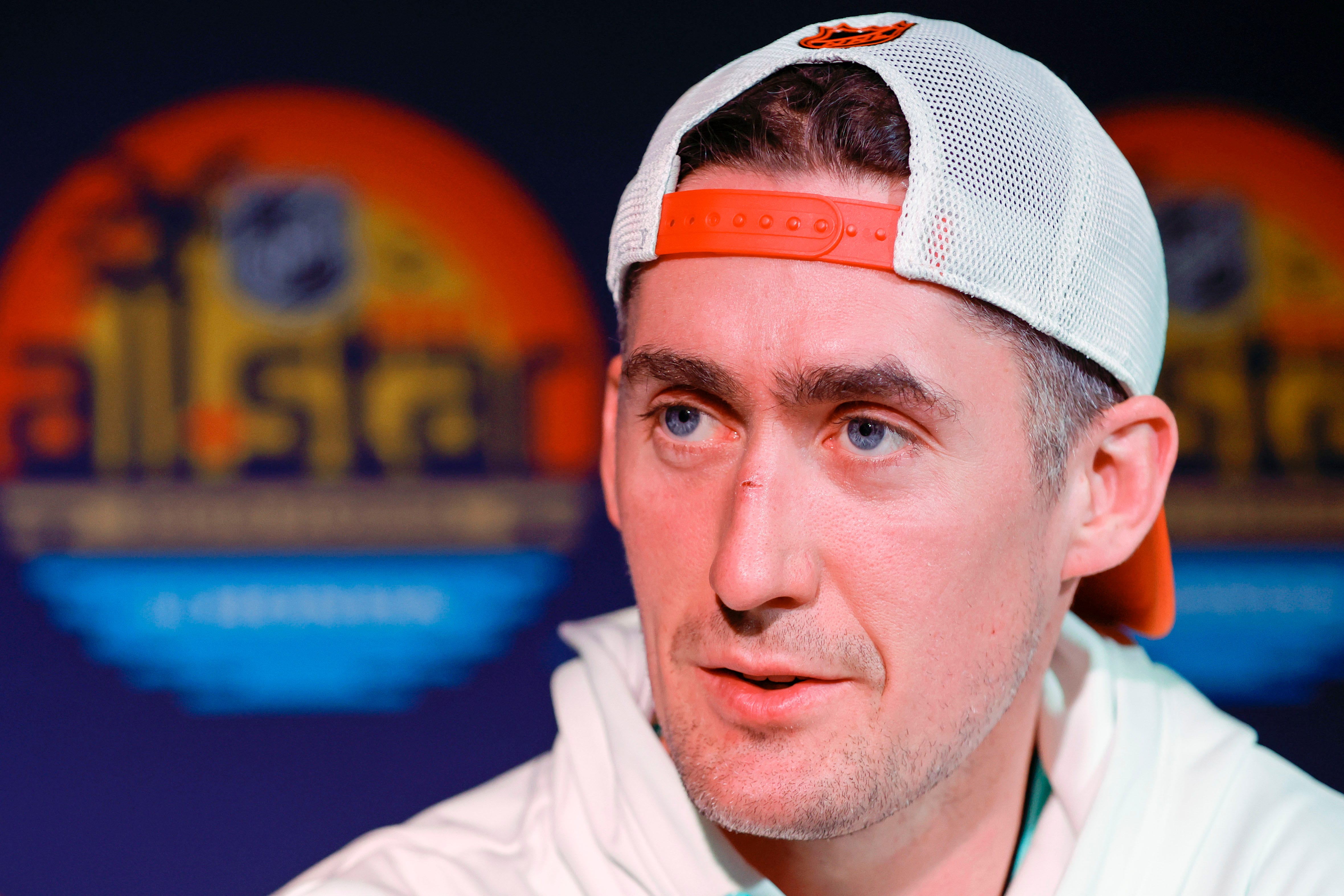
Not going to lie, but Nelson, skating with and against a ton of young bucks, seemed out of place during that tournament, with many wondering what that would mean for Team USA’s construction of their Olympic squad.
Soon after the 4 Nations Face-Off, the Islanders dealt Nelson to the Colorado Avalanche, ending an era on Long Island. Nelson re-upped with the Avalanche on a three-year, $7.5 million deal after 13 points (six goals, seven assists) in 19 regular-season games, followed by four assists in seven playoff games.
This season, Nelson has been as expected for Colorado, playing that two-way game but not losing sight of the style of play that he’s always been known for. Through 55 games this season, he has 49 points (29 goals, 20 assists). And because of his strong play, Nelson was asked to represent Team USA and thrived.
The credit goes to Nelson for how hard he’s worked in a game that’s become about young speed and skill. To survive, you have to adapt, and the Minnesota native has done that throughout his career and even more so now as he enters the back half of his NHL career.
Trotz served as the guiding light.


Your math is a bit wrong 1980 was 46 years ago not 26.
Nice article, but the 1960 Winter Olympics were in Squaw Valley, California, not in Cortina.